
Showing posts with label idioms. Show all posts
Showing posts with label idioms. Show all posts
Tuesday, November 19, 2013

Tuesday, June 18, 2013
"Saved by the Bell"- What does it mean?
 Saved by the Bell: Before modern medicine, it was hard
to determine if a person was really dead or simply in a really, really
deep sleep. As a precaution, the presumed dead were buried with a string
that ran from the corpse's finger to a bell. If there was a mistake, the
person could twitch the finger and thus be saved from being buried alive.
Saved by the Bell: Before modern medicine, it was hard
to determine if a person was really dead or simply in a really, really
deep sleep. As a precaution, the presumed dead were buried with a string
that ran from the corpse's finger to a bell. If there was a mistake, the
person could twitch the finger and thus be saved from being buried alive.http://www.neatorama.com/2008/12/08/the-science-behind-some-popular-phrases/
Meaning
Saved by a last minute intervention.
Origin
This is boxing slang that came into being in
the latter half of the 19th century. A boxer who is in danger of losing a
bout can be 'saved' from defeat by the bell that marks the end of a
round. The earliest reference to this that I can find is in the
Massachusetts newspaper The Fitchburg Daily Sentinel, February 1893:
"Martin Flaherty defeated Bobby Burns in 32 rounds by a complete knockout. Half a dozen times Flaherty was saved by the bell in the earlier rounds."
There is a widespread notion that the phrase
is from the 17th century and that it describes people being saved from
being buried alive by using a coffin with a bell attached. The idea
being that, if they were buried but later revived, they could ring the
bell and be saved from an unpleasant death. The idea is certainly
plausible as the fear of burial alive was and is real. Several prominent
people expressed this fear when close to death themselves:
"All I desire for my own burial is not to be buried alive." - Lord Chesterfield, 1769."Have me decently buried, but do not let my body be put into a vault in less than two days after I am dead." - deathbed request of George Washington."Swear to make them cut me open, so that I won't be buried alive."- Frederic Chopin's last words.
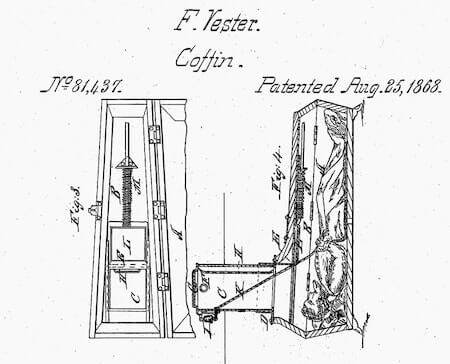
Just as real were the devices themselves,
several of which were patented in England and the USA. These were known
as 'safety coffins' and designs were registered in the 19th century and
up to as late as 1955; for example,
The Improved Burial Case. Patent No. 81,437 Franz Vester, Newark, New Jersey. August 25, 1868.
USA Patents Office |
There's no evidence to show that these coffins
were ever put to use though and there's a similar lack of evidence of
the phrase ever being used in that sense prior to it having been used in
boxing circles.
Friday, May 31, 2013
Raining Cats and Dogs- what does it mean?
 In 1600s England it was common
practice to discard any waste into the streets - even dead household pets.
In 1600s England it was common
practice to discard any waste into the streets - even dead household pets.Once it rained so much that the now-deceased Tabbies and Fidos became buoyant and floated along the streets, thus inspiring writer Richard Brome in 1651 to record,
"it shall rain dogs and polecats.
http://www.neatorama.com/2008/12/08/the-science-behind-some-popular-phrases/
Where there’s smoke, there’s fire- what does it mean?

Wednesday, May 29, 2013
"Once In a Blue Moon"- What does it mean?
 A neat description of "not
very often," it refers to the second full moon within a month - a
rare thing indeed.
A neat description of "not
very often," it refers to the second full moon within a month - a
rare thing indeed.Full moons happen about every 29.5 days, and since a typical month runs between 30 to 31 days, the likelihood of two in a month is slim.
But over the course of a century there'll be 41 months with two full moons, so once in a blue moon really means - if you want to get literal - once every 2.4 years...
http://www.neatorama.com/2008/12/08/the-science-behind-some-popular-phrases/
Subscribe to:
Posts (Atom)